Showing posts with label probiotic. Show all posts

Saturday, May 25, 2013

Feed your Internal Ecosystem with Ferments!

It's everywhere lately in science news headlines:  gut bacteria, probiotics and the microbiome.   We have a whole world of micro-organism living inside our gut as well as covering our skin: countless strains of bacteria, and possibly parasites, yeast and fungus. When the balance of this "inner world" goes out of whack, that's when digestive disorders start to occur.   Candida, colitis, IBD, IBS, Reflux, etc.  Unfortunately, the medical system doesn't have the tools yet to actually treat the root cause of these issues.  They use prescription drugs and OTC meds to give a "quick fix", but it's not sustainable and doesn't work on actually solving the problem.

So, what are some natural solutions for digestive health to keep our microbiomes healthy and happy?  We can take probiotic supplements, but it's really imperative to get the right kind for us, AND to eat lots of good prebiotic fibers. I'd recommend not taking the cheapest bottle at the store or using Culturelle or other lab-created bacteria. Consult your local Naturopath to find out which strains and products are right for you.

Another avenue is to re-introducing probiotic-rich fermented or cultured foods back into our diet.   Every culture in the world uses fermented foods in traditional cooking: sauerkraut comes from Eastern Europe, kimchi from Korea, breads like Injera (Ethiopia) and Sourdough (Egypt), Inuit people have eaten fermented whale blubber, fish sauce in Thai, Vietnamese and other Asian cultures, Kefir and Yogurt come from the Middle East and Kombucha from China.   Of course we could go on forever.  But wait...what happened to American ferments?   Seemingly around the time when we realized that there indeed microbes (aka GERMS) and Pasteur invented pasteurization, we began using high temperatures to kill the living enzymes and bacteria to "sterilize" foods.  Sadly, all of the benevolent bacteria has been stripped out of the nouveau Americana culture of culture-less and highly processed food.  It's time to reclaim our right to living foods, ferments!
Today's buy from Eastern Market!

Fermented foods are "rotted"; they are partially digested from bacteria already.  For example, cabbage has a fine film of bacteria on each leaf.  When shredded up and mixed with a salty brine and submerged in an anaerobic state, the bacteria go though a few-step process (that is a little over my head) to create a beneficial  bacteria-rich veggie that ALSO has prebiotic fiber all in one.  By the time the ferment is, well, fermented, the veggies are salty, still crispy, and deliciously soured.  The good news is that fermenting is simple and we don't have to be experts in the chemical processes by which it works to reap the rewards.  If this is interesting to you, I suggest reading some Sandor Katz's books, which do an excellent job of sharing the history of these foods and teach how to start making DIY ferments at home!

Some of my first DIY ferments. Plain kraut in the middle, kim chi on the sides.


It's fairly easy and highly enjoyable to make fermented foods at home!  I have been experimenting with krauts and other veggies as well as kombucha for the last couple year.   I say "experiment" because each batch is decidedly different; it's a delightful surprise to open up a crock of fermented veggies after 4 weeks or try a new flavor of DIY kombucha after its 2nd ferment.  Luckily, if you don't have the time or will to do it on your own just yet, there is access to other people's fermented goodness!  Small batch fermenters are popping up local foodie sub-cultures, like The Brinery in Ann Arbor and Farmhouse Culture in Northern California.  I've even seen some farms adding their local ferments to Saturday offerings at the Royal Oak Farmer's Market.  Now that you can buy locally, or make your own, how do we incorporate them into our diet?

Kombucha tea!  After the first ferment, I like to add blueberries, ginger, or other goodies and let it sit a few more days. 

You can start the day with a glass of kombucha, or have a bowl of fresh yogurt or kefir with fruit.   Sauerkraut and kimchi add a delicious sourness, salt and crunch to sandwiches for lunch.  At dinner time, I like to eat a 1/4 cup with my meal, kind of as a little accouterments.  I encourage everyone to try fermented foods.  It's an acquired taste, but one that will give you billions of little benefits and keep your digestion on track. :)


Awesome lunch: chicken salad, kale and kraut on a sprouted organic grain and bean wrap and Coconut Kefir to drink!


Friday, January 4, 2013

Banana-Flax Smoothie {vegan}

This hearty morning smoothie is a meal-in-a-cup and excellent for digestion.  The flax is rich in fiber and a good source of Omega-3.  When soaked in water overnight, the flax seeds double in size and you'll notice a a gelatinous coating.  The soaking is important - as with other nuts, beans  and seeds - because it lessens the amount of phytic acid.


Banana-Flax Smoothie

1 medium banana
2 ice cubes
1/2 c coconut milk - or other alternative milk like almond
2 tbsp soaked flax seeds
2 tbsp sunflower seed butter or other nut butter
1 tsp bee pollen (optional)
**Your probiotics, fiber, etc.

Blend on high for 1-2 minutes!  You can also add honey, but I find this plenty sweet from the banana.


Nutrition

389 calories
11 g protein
38 g carbs
23 g fat

Tuesday, August 14, 2012

PB and Banana Probiotic Smoothie {vegan}

Probiotics and gut-bacteria are a hot topic of discussion these days, for good reason! The easiest and most delicious way for me to take my probiotics is in this breakfast smoothie! This is one of our favorites and I can say that I never get sick of the peanut butter and banana flavor.  Here's the recipe first, and then some info and thoughts on probiotics.


Peanut Butter and Banana Probiotic (and Prebiotic) Smoothie!

Ingredients:


1 banana (prebiotic)
2 tbsp organic peanut butter (prebiotic)
2 ice cubes
Approx 1 c almond or coconut milk
1 c dark leafy greens (Rainbow Chard here) (prebiotic)
1 tbsp (large pinch) sea dulse
**Klaire Labs Vital-10 Probiotic Powder 1/4 tsp  (probiotic)

Directions:

Blend and enjoy immediately. The peanut butter and banana flavors definitely overpower the greens and dulse.  

**Consult your Naturopath to find a probiotic product that's right for you.

Nutrition: 

366 calories
12 g protein
20 g fat
42 g carb
Rich in both micro and macro nutrients!

PROBIOTICS and THE GUT

Do you take a probiotic?   There's a lot of information, both helpful and misleading about these "good bacteria" right now.  What is a probiotic?

Probiotics are living microorganisms which colonize the digestive tract and help support the proper functioning of the human body. It's important to understand not all forms of bacteria considered beneficial to the body are termed "probiotic." Instead, this term is reserved only for those bacteria capable of withstanding the highly acidic environment of the stomach while passing to other areas of the digestive system to perform their life-sustaining duties. ~Dr. Matthew Marturano, ND. 

Antibiotics and a highly processed diet have joined forces to wipe our systems out of the good kind of bacteria, making it easier for "bad" bacteria and other parasites and yeast to thrive.  Over 100 million Americans have stomach issues, but reculturing our gut with the "good bacteria" can help heal many digestive symptoms like IBS, GERD, Bloating, Constipation, etc. Once we get the good bacteria or probiotics in there, we also have to feed them so they can thrive in a happy healthy environment - your gut!

SOURCES OF PROBIOTICS:
  • Fermented vegetables like kimchi, sauerkraut
  • Kombucha (a fermented sweet tea grown from a SCOBY) or kefir milk or water
  • Yogurt - choose an organic or greek variety, not fruity high-sugar stuff and please not Activia
  • Cultured grains like sourdough bread
  • Probiotic supplement (from a naturally occurring strain - not this pharma crap like Activa, Culturelle, etc. They have made these strains in a lab which is why they can patent them)
Along with the probiotic, we need a PRE-biotic to feed the gut bacteria. As you'll see, these are high-fiber plant based foods.

SOURCES OF PREBIOTICS:
  • Fruits like banana, raisins, apples, blackberries, blueberries
  • Whole grains like oatmeal, wheat, barley, rye (WHOLE means whole; in it's unprocessed form)
  • Legumes like beans, lentils, peanuts, etc. 
  • Vegetables like dark leafy greens, onions, garlic, asparagus, artichoke & more
So, you can see why this is the perfect probiotic & prebiotic smoothie.   Hope you enjoy!


Friday, January 14, 2011

Yogurt: breakfast, digestive health and why Activia is a terrible choice.

You know you should eat your breakfast; your momma told you so.  Then again, so did Wheaties and Pop Tart and Jimmy Dean and Tim Horton.   But all breakfasts are not created equally. Cereal? Bagel? Pop tart and OJ? Greasy breakfast sandwich that could sit on your counter NOT growing mold for a year or so?  Not so much balanced breakfast ideas.   Having a breakfast of sugar and carbohydrates might give you a quick boost, but you'll crash and be cranky and starving by lunchtime.   Protein is essential to keeping your body functioning properly.  So, what do you do for QUICK weekday breakfasts that are healthy and cheap?


YOGURT!  Whole, real, full-fat, plain yogurt like Seven Star Farms.  They are cultured products, which means the good microbes are still alive and haven't been killed by pasteurizing the product.  Probiotics and enzymes are fantastic natural solutions for digestive health. Real yogurt actually TASTES like yogurt; tangy and tart and with a little bit of texture.  If you're protein-conscious, Greek Yogurt is a great choice.   Because Greek yogurt has been strained to remove excess whey, it is thicker and the protein content is much higher than regular yogurt.  To me the extra protein is worth the extra couple bucks.  Greek yogurt is super filling, so I tend to do 1/2 c servings rather than a whole cup.

NO-gurt.  What kind of yogurt is a bad idea?  All of the ones in little, convenient cups and filled with real & fake sugars + additives, colors, preservatives, namely Activia.  Yeah, that might sound counter-intuitive, because of all of the TV ads and claims that it has healthy probiotics.  Guess what?  The probiotic they use, Bifidus Regularis (LOL) has been manufactured just for them in a laboratory, people.  It's not a naturally occurring one like you'll find in the types I've mentioned above. So, not only are we unsure of what actual benefits this modified organism has, it's just plain snakey for Dannon Corporation to create and patent the living organism and profit off of YOU.

/rant.

If you work in an office, keep the "toppings" in baggies at your desk, and bring in a large container of Yogurt and some real fruit in at the beginning of each week. There. Now you officially have no more excuses of "wahhhh.....I don't have time for a healthy breakfast!!!".

Here are some of my favorite yogurt "recipes" but feel free to mix, match, substitute and create your perfect blend. 

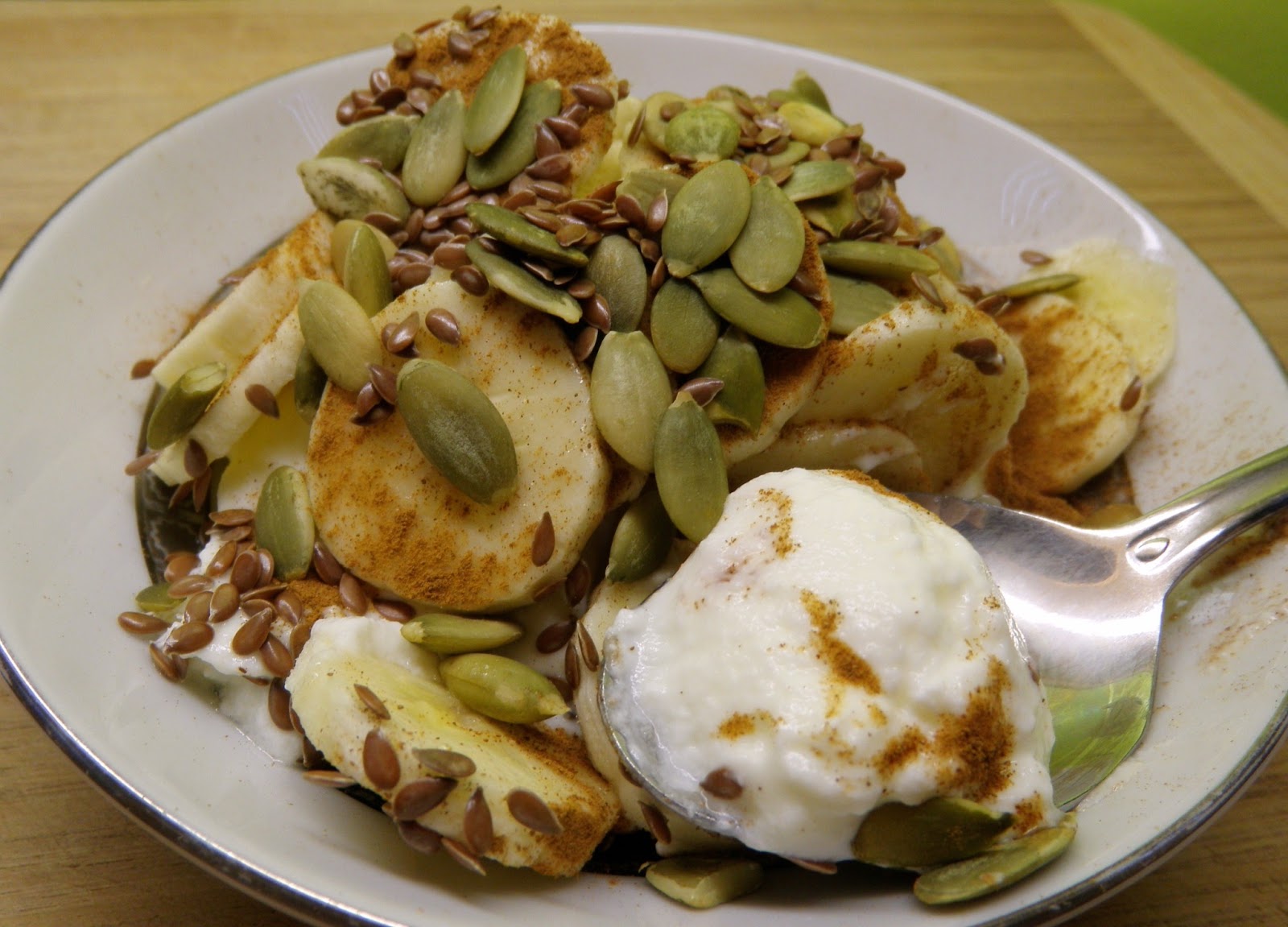
SEED-TASTIC

1/2 c Whole-Milk yogurt
1 oz pepita seeds
1 tsp flax seeds
1/2 banana, sliced
Pinch of cinnamon

AMBROSIA


1/2 c Greek yogurt
Drizzle of honey
1/2 orange
1/2 oz almonds
1/2 oz unsweetened coconut flakes

250 calories
14 g protein
10 g fat
21 g carbs

BERRY BLAST


1/2 c Greek yogurt
1/3 c frozen or fresh blueberries
2 tbsp tart cherry juice concentrate
1/2 oz walnuts

261 calories
13 g protein
10 g fat
32 g carbs


GRANOLA CRUNCHER


1/2 c Greek yogurt
2 tbsp granola
2 tbsp dried fruit (cherry cranberry mix is my favorite)
1/2 oz pecans

325 calories
14 g protein
15g fat
33 carbs

SUPER PROTEIN (If you're working out a ton, this is a good choice!)


1 cup Greek Yogurt
1/2 banana
2 scoops whey protein powder (I used chocolate)

289 calories
36 g protein
3 g fat
32 g carbs

http://www.foodrenegade.com/about/fight-back-fridays/